Fort Zachary Taylor is one of those Key West places that can surprise you twice. First, there is the setting: a massive brick fort tucked beside one of the island’s favorite beaches. Then there is the history. Behind those shaded archways and weathered walls is a story of military strategy, Union-held Key West and cannons that spent decades buried inside the fort itself.
Today, “Fort Zach” is an easy place to mix a little time travel with a relaxed afternoon by the water. You can wander through old gun rooms, stand beside historic artillery and then trade the brick corridors for snorkeling, swimming or a picnic beneath the trees. That combination makes it much more than a stop for dedicated history buffs.
A Fort Built to Guard Key West
The United States established a naval depot in Key West in 1822, recognizing the island’s value near important shipping routes. Construction of Fort Taylor began in 1845 on a sandy shoal roughly 400 yards offshore. Named for Zachary Taylor, the Army officer who later became the nation’s 12th president, the fort was designed to help protect Key West’s harbor and the surrounding waters.
The project was ambitious. The original fort had three tiers of gun rooms, known as casemates, along with barracks arranged around a central parade ground. Its position allowed the Army to watch the water approaches to Key West. Construction continued for 21 years, meaning the fort was still unfinished when the Civil War began and was not completed until 1866.
You can follow the construction timeline through the official Florida State Parks history of Fort Zachary Taylor and see period plans and illustrations in the U.S. Army Center of Military History’s Fort Taylor collection.
Why Key West Stayed in Union Hands
Florida joined the Confederacy in 1861, but Fort Taylor did not. Federal troops secured the fort at the beginning of the conflict, and it remained under Union control throughout the Civil War—one of only three federal fortresses in Florida to do so.
That made Key West an unusual Union stronghold in a Confederate state. The fort helped protect the harbor and supported federal blockading operations around the Florida Keys. Its guns also gave Union forces a powerful position from which to discourage an attack and detain blockade runners brought into Key West.
There was no dramatic land battle at Fort Taylor. Its importance was strategic: possession of the fort helped the Union hold Key West and use the island as a base for operations at sea. Sometimes the most valuable fortress is the one imposing enough that an enemy decides not to test it.

What the Civil War Fort Looked Like
Visitors who walk through Fort Taylor today are seeing only part of its original scale. During the Civil War era, the fort rose three stories and stood almost entirely surrounded by water. Rows of brick arches held heavy artillery, while soldiers lived and worked in a remote military complex separated from the town of Key West.
The surviving casemates still give the place a powerful atmosphere. Step inside and the heat drops, voices echo against the brick and the waterfront seems suddenly far away. It is much easier to imagine the daily routine of a 19th-century garrison when you are standing where soldiers stored equipment, handled ammunition and watched the harbor.
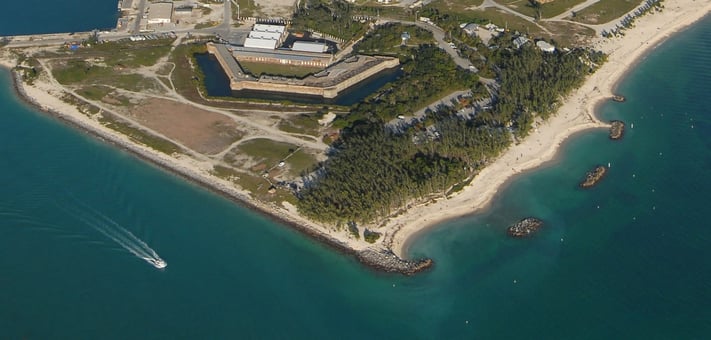
Photo Credit: United States National Archives
The Cannons Hidden Inside the Fort
One of Fort Taylor’s best stories began long after the Civil War. Between 1898 and 1905, the Army modernized the site for newer coastal artillery. The upper two tiers were removed, and parts of the old fort—including Civil War-era cannons, projectiles and other military material—were buried beneath new construction and fill.
There they remained until 1968, when Navy engineer Howard S. England began investigating what looked like an overgrown dumping area. The excavation revealed an extraordinary collection of historic armaments, along with other artifacts from the fort’s earlier years. A practical remodeling decision had accidentally turned part of the fort into a sealed military time capsule.
The discoveries helped historians better understand the original fortress and contributed to its preservation. Florida State Parks tells more of the excavation story in “Where Do You Keep a Cannon?”.
A Military Landmark That Kept Changing
Fort Taylor’s story did not end with the Civil War. The site was adapted during the Spanish-American War and remained part of the nation’s coastal defenses through both world wars. It also had a role during the Cuban Missile Crisis. Each new era brought different weapons, altered walls and changing military needs.
The fort originally stood offshore with only a causeway connecting it to Key West. In the mid-1960s, Navy dredging and land-reclamation work filled the water between the fort and the island, creating much of the land visitors cross today. The Army’s active use of the fort had ended after World War II, and the historic site was designated a National Historic Landmark in 1968.
That long evolution explains why the fort does not look exactly as it did in 1861. What remains is a layered record of American coastal defense rather than a building frozen at one moment in time.
How to Experience Fort Zachary Taylor Today
Start with the fort itself. Interpretive panels and self-guided materials help explain the casemates, artillery and changing design. A guided tour is generally offered at 11 a.m., but times and programs can change, so confirm the day’s schedule on the official tours and events page before planning around it.
Give yourself time to explore slowly. The fort becomes more interesting when you look beyond the cannons: notice the thickness of the walls, the curve of the brick ceilings and the contrast between the dark casemates and bright Key West sky.
Afterward, the rest of the state park is ready for a completely different kind of afternoon. The beach is popular for swimming and snorkeling, shaded picnic areas make an easy lunch stop, and the park has a café plus rentals that may include chairs, umbrellas and snorkel gear. Conditions and concession hours can vary, so use the Fort Zachary Taylor Historic State Park visitor page for the latest details.
For more help deciding how to divide your time between the fort and beach, see our six reasons to visit Fort Zachary Taylor. You can also compare the setting with other island favorites in our guide to the best beaches in Key West.
Plan Your Visit
- Location: 601 Howard England Way, Key West, Florida 33040.
- Park hours: The park is generally open from 8 a.m. until sunset, while the fort closes at 5 p.m. Check the official park page for current hours, admission fees and temporary notices.
- From Key West Express: The park is approximately 1.8 miles from the Key West terminal. Walking is possible, but a bicycle, taxi or rideshare can be more comfortable on a hot day. Our Fort Zachary Taylor State Park & Beach guide has the quick visitor details.
- What to bring: Comfortable walking shoes, water, sun protection and swim gear if the beach is part of your plan. Water shoes can be useful along the rocky shoreline.
- How much time to allow: Plan on at least one to two hours for the fort. Add more time if you want to swim, snorkel, picnic or simply enjoy the waterfront.
Explore Key West With Key West Express
Fort Zachary Taylor is a perfect example of what makes Key West so much fun to explore: one stop can hold more than a century of military history, a beautiful waterfront and an easygoing beach afternoon.
Begin your trip aboard Key West Express from Fort Myers Beach and enjoy the ride across the Gulf before arriving within easy reach of Old Town. Browse our Fort Myers Beach Prepare & Go guide, review current Key West Express fares and travel information, and book your trip to Key West when you are ready.