Key West may be famous for sunsets, tropical drinks and turquoise water, but look beyond the island atmosphere and you'll discover one of Florida's most fascinating historical destinations.
For more than two centuries, Key West has been shaped by sailors, wreckers, soldiers, cigar makers, presidents, writers, artists and immigrants from Cuba, the Bahamas and beyond. Its strategic location between the Atlantic, the Gulf and the Caribbean helped turn a small island into a surprisingly important center of maritime trade, military defense and cultural exchange.
Better yet, much of that history is concentrated within Old Town. Arrive aboard Key West Express, and you'll step ashore within easy reach of museums, historic homes and neighborhoods where those stories actually unfolded.
If history is your reason for exploring, here are some of the places—and stories—you won't want to miss.
Start With the Story of Key West
Long before today's Old Town streets existed, the island was known by its Spanish name, Cayo Hueso. By the early 1800s, Key West's location near busy shipping routes was beginning to shape its future.
The United States established a naval presence here in 1822, and the island grew rapidly as fishing, wrecking, shipping and later cigar manufacturing brought people and prosperity to the southernmost city.
But Key West's history is much bigger than one industry or era. Cuban immigrants helped shape the cigar industry and supported Cuba's independence movement. Bahamian settlers contributed to the island's maritime economy and culture. Military installations protected strategically important waters, while writers and artists transformed Key West into a cultural destination.
For a deeper look at those influences, explore our guides to Key West's Cuban heritage and Bahama Village, one of Old Town's most historically significant neighborhoods.
_Pirate.jpg?width=450&height=338&name=Key_West_2008_(2338535918)_Pirate.jpg) Photo Credit: Wikimedia Commons
Photo Credit: Wikimedia Commons
Key West Museum of Art & History at the Custom House
The massive red-brick Custom House near Mallory Square is hard to miss—and it's an excellent place to begin exploring Key West history.
Completed in the late 1800s, the building has served several important roles during its life, including customs operations, postal service and federal courts. Today it is operated by the Key West Art & Historical Society as the Key West Museum of Art & History at the Custom House.

Inside, exhibits explore the people, industries, art and events that shaped the Florida Keys. The building itself is part of the experience: its distinctive architecture reflects an era when Key West's importance as a port was visible in the scale and ambition of its public buildings.
It is also conveniently located near Mallory Square, the Truman Annex and several other historical attractions, making it an easy anchor for a history-focused day in Old Town.
Walk Through Presidential History at the Truman Little White House
A short distance away in the Truman Annex is one of Key West's most nationally significant historic homes: the Harry S. Truman Little White House.
President Harry S. Truman first came to Key West in 1946 and ultimately made 11 presidential working vacations to the island, spending a combined 175 days here during his presidency. This wasn't simply a vacation house. Truman continued conducting the nation's business while in Key West, turning the former naval residence into a functioning presidential retreat.
Today, visitors can tour the house and learn about Truman's presidency, his time in Key West and the decisions and personalities that passed through this unlikely presidential outpost.
The surrounding Truman Annex is also worth exploring. What is now a beautiful residential neighborhood grew from Key West's long military and naval history.
-Sized.jpg?width=450&height=300&name=Truman_Little_White_House%2c_Key_West%2c_FL%2c_US_(08)-Sized.jpg) Photo Credit: Judson McCranie via Wikimedia Commons
Photo Credit: Judson McCranie via Wikimedia Commons
Explore Key West's Civil War History at Fort Zachary Taylor
Continue toward the waterfront and you'll encounter one of Key West's most impressive historical landmarks: Fort Zachary Taylor Historic State Park.
Construction of Fort Taylor began in 1845 as part of America's coastal-defense system. When the Civil War began, the fort remained under Union control and helped support the Federal Navy's blockade operations. Today, Fort Zachary Taylor is a National Historic Landmark and contains an extraordinary collection of Civil War-era seacoast artillery.
Walk through the fort's brick corridors, gun rooms and archways and it becomes much easier to understand Key West's strategic importance.
We've explored that story in much greater detail in Inside Fort Zachary Taylor: Key West's Civil War Fortress by the Sea. You can also use our Fort Zachary Taylor State Park & Beach guide when planning your visit.
One reason Fort Zachary Taylor is especially unusual is that history isn't the only attraction. After touring the fort, you can head to the beach, swim, snorkel or enjoy a picnic overlooking the water.
Discover the Island's Maritime and Shipwreck History
To understand how Key West became prosperous, you have to understand the sea.
During the 1800s, vessels regularly wrecked along the dangerous reefs surrounding the Florida Keys. Wreckers raced to distressed ships to rescue passengers and crews and salvage valuable cargo. The resulting industry became an important part of Key West's early economy.
The Key West Shipwreck Treasure Museum near Mallory Square recreates that era through artifacts, storytelling and exhibits inspired by the island's 19th-century wrecking industry. Visitors can also climb the museum's observation tower for views across Old Town and the surrounding waterfront.
For another side of Key West's maritime story, visit the Mel Fisher Maritime Museum. Its collections include artifacts recovered from historic shipwrecks, most famously the Spanish galleon Nuestra Señora de Atocha.
And don't stop at the museums. A walk through the Key West Historic Seaport and Key West Bight connects today's working waterfront with generations of fishing, trade and island life.
Step Into Ernest Hemingway's Key West
Key West history isn't limited to forts and shipwrecks. The island also became home to one of America's most famous writers.
Ernest Hemingway and his wife Pauline made the Whitehead Street house their home in the 1930s. Built in 1851, the Spanish Colonial residence became the setting for some of Hemingway's most productive years. His separate writing studio, personal furnishings and the lush grounds help tell the story of his Key West life.
Then there's the swimming pool.
Built in 1937–38, it was the first in-ground swimming pool in Key West and, according to the Hemingway Home, the only pool within 100 miles at the time. And yes, the property's famous six-toed cats remain part of the experience today.
Our Ernest Hemingway Home & Museum guide has additional information for planning your visit.
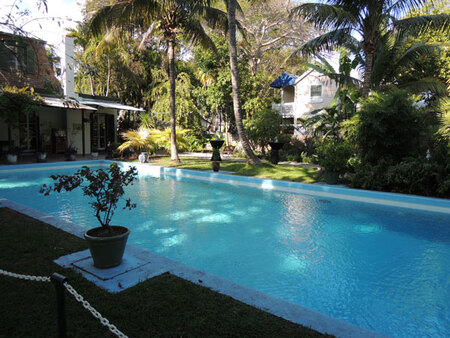 Photo Credit: Abujoy via Wikimedia Commons
Look Beyond the Famous Names
Some of the best Key West history isn't attached to a president or internationally famous author.
Walk through Bahama Village and you'll discover a neighborhood shaped by generations of Bahamian and Black residents whose work, churches, homes and traditions became part of the island's identity.
Explore Key West's Cuban heritage and another layer appears—cigar factories, political activism, architecture, food and cultural connections between Key West and Cuba that stretch back generations.
Art tells the story too. Key West-born folk artist Mario Sanchez documented everyday island life in detailed painted woodcarvings, preserving scenes of streets, businesses, celebrations and neighbors that might otherwise have disappeared from memory.
Together, these stories make Key West history much richer than a checklist of famous buildings.
Let Old Town Be the Museum
You don't necessarily have to walk through a museum door to encounter Key West history.
Old Town itself is filled with historic architecture, narrow streets, wooden Conch houses, old churches and buildings that reflect the island's Bahamian, Cuban, maritime and military past.
Whitehead Street, Duval Street, Bahama Village, the Truman Annex, Mallory Square and the Historic Seaport can all become part of a self-guided history tour.
Our Key West Walking Tour Guide is a good starting point if you want to explore on foot. If you'd rather cover more ground while hearing the stories along the way, the Conch Tour Train and Old Town Trolley offer narrated ways to experience the historic district.
And don't overlook Duval Street. Behind its restaurants, shops and nightlife is nearly two centuries of Key West commerce and culture.
How to Plan a Key West History Day
If you only have one day, don't try to see everything.
Start near the waterfront with the Custom House and maritime history around Mallory Square. From there, continue through the Truman Annex to the Little White House and Fort Zachary Taylor.
Then work your way toward Whitehead Street for the Hemingway Home and surrounding Old Town landmarks.
If you're staying longer, use your second day to dig deeper. Visit the Mel Fisher Maritime Museum, explore Bahama Village, walk the Historic Seaport and spend more time discovering the neighborhoods between the major attractions.
The important thing is to leave room for wandering. In Key West, some of the most interesting pieces of history aren't behind glass—they're built into the streets around you.
Sail Into the History of Key West
One of the things that makes Key West special is that its history never feels very far away.
A former presidential retreat sits inside an old naval district. A Civil War fort shares its grounds with one of the island's favorite beaches. Shipwreck treasures tell stories of fortunes made at sea, while historic neighborhoods preserve the influence of generations who came from Cuba and the Bahamas.
And throughout Old Town, the past continues to live alongside the Key West of today.
Travel aboard Key West Express from Fort Myers Beach, arrive near the Historic Seaport and begin exploring an island whose history is every bit as colorful as its sunsets.