Imagine being able to close your eyes and remember the neighborhood where you grew up—not just the buildings and streets, but the people sitting on their porches, children playing in the afternoon sunshine, and the everyday moments that made your community special.
Now imagine bringing those memories back to life through art.
That's exactly what Mario Sanchez, one of Key West's most celebrated folk artists, spent much of his life doing.
Working from a modest outdoor studio surrounded by tropical trees, Sanchez created hundreds of colorful woodcarvings depicting the people, traditions, neighborhoods and everyday experiences of Old Key West.
His artwork became something extraordinary: a visual record of an island community that was changing with every passing generation.
And the place where much of that remarkable work was created?
He called it Mario's Studio Under the Trees.
Growing Up in Old Key West
Mario Sanchez was born on October 7, 1908, in Key West, Florida.
His family had deep connections to the island's Cuban community. He was born above the family grocery store, or bodega, at the corner of Duval and Louisa streets.
Much of his childhood was spent in a neighborhood known as Gato Village, or El Barrio de Gato, named for Eduardo Hidalgo Gato, a prominent Cuban cigar manufacturer.
During the early 20th century, Key West was a bustling community shaped by Cuban immigrants, Bahamian families, fishermen, cigar makers, merchants and maritime workers.
The streets were filled with activity.

Neighbors gathered on porches. Children played homemade games. Vendors sold their goods. Cigar factories employed generations of island residents.
These ordinary moments would eventually become the subjects of Sanchez's extraordinary artwork.
His father, Pedro Sanchez, worked as a lector, reading newspapers, literature and other material aloud to cigar workers as they worked.
That connection to storytelling, community and Cuban heritage would become an important part of Mario's artistic legacy.
From Grocery Bags to Works of Art
Mario Sanchez never received formal artistic training.
Instead, he developed his distinctive style through observation, experimentation and an almost photographic memory.
Around 1930, he began carving life-sized representations of fish found in the waters surrounding Key West.
His materials were often simple and inexpensive.
Discarded wooden boards from tobacco crates provided surfaces for his carvings. Brown grocery bags became sketch paper.
He would first draw a scene, transfer the image onto wood, and carefully carve away the surrounding material to create a raised design.
The technique is known as bas-relief carving, and Sanchez's finished works are frequently described as intaglios.
He then brought the scenes to life with color.
In his early work, Sanchez experimented with pigments and materials that included coffee grounds and egg yolks.
What began as a creative hobby eventually developed into one of the most distinctive artistic styles associated with Key West.
An Island Artist Inspired by the Sea
One of Sanchez's earliest subjects was the colorful marine life of the Florida Keys.
His carved fish reflected the waters that surrounded the island and the fishing culture that was central to everyday Key West life.
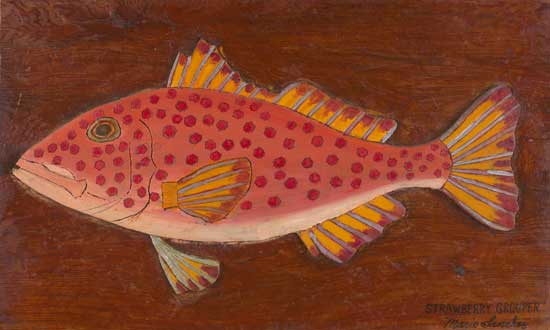
As his artistic interests expanded, Sanchez began moving beyond fish and marine life.
Encouraged by his mother-in-law, he started recreating scenes from the Key West of his childhood.
That decision would define his artistic career.
Painting the People and Traditions of Key West
What makes Mario Sanchez's artwork so special isn't simply the colorful style or intricate carving.
It's the stories.
His work depicts a Key West that existed long before modern resorts, busy tourism districts and the island's present-day reputation as a vacation destination.
Among his favorite subjects were:
- Children flying Cuban kites and playing neighborhood games.
- Fishermen returning with their daily catch.
- Workers and activity surrounding the island's cigar factories.
- Bahamian funeral processions.
- Cuban dancers, musicians and street celebrations.
- Local businesses, homes and neighborhood characters.
- Everyday gatherings that brought island residents together.
Many of the people represented in his carvings were real individuals Sanchez remembered from his childhood.
Even the buildings and street scenes were often recreated from memory.
Rather than inventing an idealized version of Key West, Sanchez wanted to preserve the island as he remembered it.
His art celebrates the cultural connections between Cuban, Bahamian and American communities that helped shape the island's identity.
Today, those carvings provide a remarkable glimpse into the social history of early 20th-century Key West.
Mario's Studio Under the Trees
Despite the growing recognition of his artwork, Mario Sanchez remained closely connected to his Key West roots.
For decades, he worked from a modest studio on his family's property.
A hand-painted sign identified the workspace as Mario's Studio Under the Trees.
It was an appropriate name.
Rather than working in an elaborate gallery or formal artist's studio, Sanchez carved and painted in the familiar surroundings of his family compound, beneath the tropical trees of Old Key West.
His tools were simple.
His materials were modest.
But his imagination and memories were extraordinary.
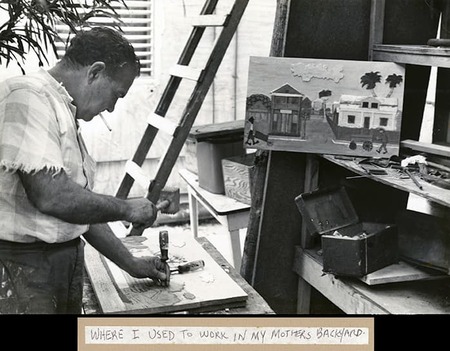
Visitors and neighbors could watch him transform an ordinary piece of wood into a detailed scene from the island's past.
It was a remarkably personal way of creating art.
And perhaps that's why his work continues to resonate with people who appreciate the history and character of Key West.
Recognition for a Remarkable Key West Artist
Mario Sanchez's artistic reputation grew steadily throughout his life.
In 1946, he sold one of his early scenes, Manungo's Diablito Dancers.
His work began appearing in public exhibitions, including an important 1961 exhibition at Key West's East Martello Gallery and Museum.
In 1970, Sanchez left his regular employment to devote himself to art full-time.
Over his lifetime, he created more than 600 painted woodcarvings, documenting generations of island life.
His achievements received statewide recognition in 1985 when he was awarded the Florida Folk Heritage Award.
The honor recognized his exceptional contribution to preserving Florida's traditional arts and cultural heritage.
Sanchez continued creating artwork well into his later years.
He died in 2005, leaving behind an extraordinary collection of images documenting a Key West that might otherwise have disappeared from living memory.
Why Mario Sanchez's Artwork Still Matters
Key West has changed considerably since Sanchez's childhood.
The cigar factories that once helped power the island's economy are largely gone.
Neighborhoods have evolved.
Businesses have changed hands, historic buildings have disappeared, and generations of residents have come and gone.
But through Sanchez's artwork, many of those earlier experiences remain visible.
His carvings preserve more than architecture and street scenes.
They preserve the personality of a community.
You can see the influence of Cuban culture, Bahamian traditions, working waterfronts, family businesses and the everyday relationships that made Old Key West distinctive.
For visitors interested in discovering the island beyond Duval Street and its famous attractions, Sanchez's artwork offers an entirely different perspective.
It reminds us that Key West isn't simply a vacation destination.
It's a place with a rich, multicultural history worth understanding and preserving.
Where Can You See Mario Sanchez's Artwork in Key West?
Fortunately, you don't have to rely on photographs to appreciate Mario Sanchez's work.
Several Key West cultural institutions help preserve and showcase his legacy.
Gallery on Greene
Located at 606 Greene Street, Gallery on Greene is one of the best places to discover Mario Sanchez's distinctive artwork.
The gallery features Sanchez's original carvings, related artwork and reproductions, alongside works by other artists connected to Key West and Cuba.
Visitors can explore the detailed scenes that made Sanchez famous and learn more about his contributions to the island's artistic heritage.
Visit the Gallery on Greene website for current information and available artwork.
Key West Museum of Art & History at the Custom House
The Key West Art & Historical Society maintains an important collection of Mario Sanchez artwork.
Its holdings include carved wooden scenes, preparatory drawings and other materials connected to his artistic career.
The Society's collection has grown to more than 200 Sanchez-related works and objects, helping preserve his artistic legacy for future generations.
The Key West Museum of Art & History at the Custom House, located at 281 Front Street, presents exhibitions exploring the island's cultural history and artistic traditions.
Because exhibitions change, check the Society's website to determine whether Sanchez artwork is currently on display.
Visit the Key West Art & Historical Society for current exhibitions and museum information.
Discover More of Key West's Artistic Heritage
Mario Sanchez is an important part of Key West's artistic history, but he's far from the only artist inspired by the island.
Key West has attracted painters, sculptors, photographers, writers and creative personalities for generations.
Its colorful architecture, tropical landscapes, Caribbean influences and independent spirit continue to inspire artists today.
If you'd like to explore more of the island's creative side, our Key West Art in One Day: A Walkable Art Lover's Itinerary provides a convenient introduction to galleries, museums and historic sites around Old Town.
You can also follow our Key West Walking Tour Guide to discover historic neighborhoods, architecture and landmarks that connect today's island with its fascinating past.
Both are excellent ways to experience a side of Key West that goes well beyond the usual tourist attractions.
Experience the Stories of Key West for Yourself
Mario Sanchez spent his life preserving the Key West he remembered.
Through his colorful woodcarvings, generations of visitors can experience the island's historic neighborhoods, traditions and people long after the world he depicted has changed.
His artwork reminds us that some of Key West's greatest treasures aren't found on a beach or behind a famous bar.
They're found in the stories of the people who made the island what it is today.
And discovering those stories is part of what makes visiting Key West so special.
Key West Express makes exploring the island easy. Depart from Fort Myers Beach, enjoy a relaxing cruise across the Gulf, and arrive near the Historic Seaport and Old Town.
From there, galleries, museums, historic neighborhoods and countless other discoveries await.
Plan your Key West getaway aboard Key West Express and discover the island's artistic heritage for yourself.